
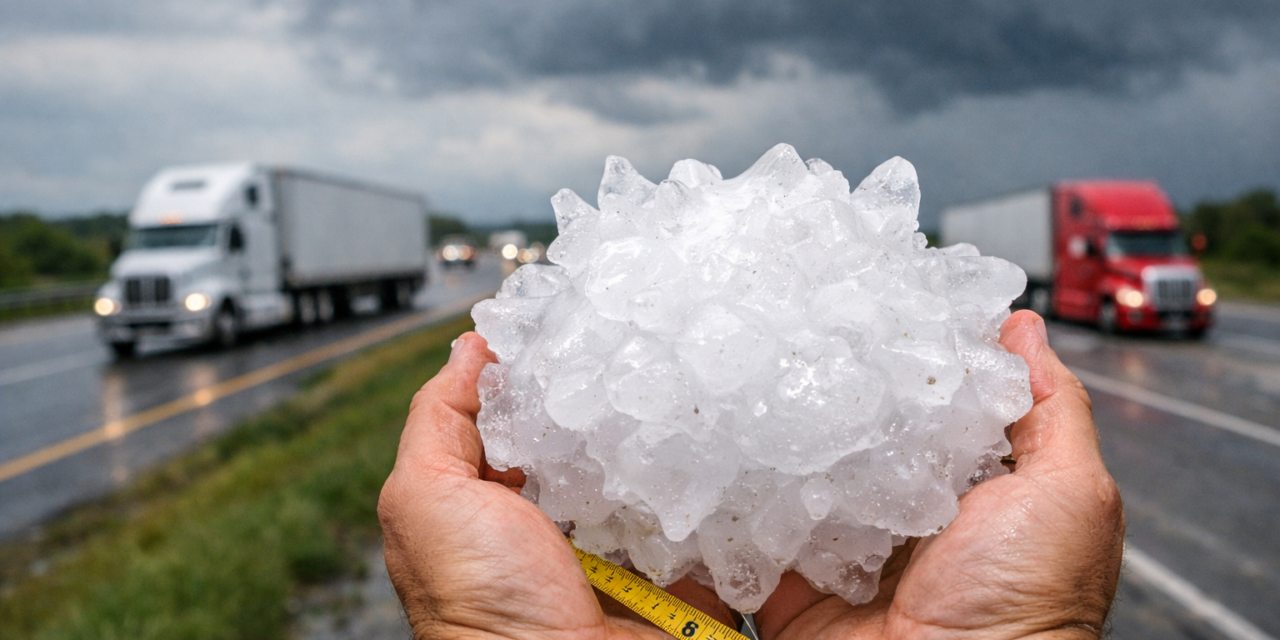
Severe weather is usually covered as a consumer story first: giant hail, damaged cars, smashed windows, downed trees, and neighborhoods picking through debris. For trucking, the story is different. The first hit is operational. The second hit is logistical. And the storms that moved through Kansas City and Kankakee on March 10, 2026, are a good example of both.
In the Kansas City metro, storm reports described hail up to about 4 inches near Weatherby Lake in Platte County, Missouri. In the Kankakee area, the storm produced giant hail ranging from 3 to locally 6 inches, including a hailstone later measured at 6.616 inches and 557.2 grams, putting it in line to become the largest hailstone ever officially recorded in Illinois pending final verification.
For carriers, brokers, and shippers, that matters because these were not random places to get hit. Kansas City sits on one of the country’s most important freight networks, with major corridors including I-29, I-35, I-49, I-70, I-435, I-470, I-635, and I-670. In Kankakee County, I-57 is a vital transportation link and a major connector for freight moving through the region. This was not just a weather event. It was a weather event landing directly on freight geography.
The first freight problem: weather stops being background noise

The immediate freight effect of a hailstorm is not higher volume. It is disruption.
When large hail, tornado warnings, poor visibility, and sudden wind move into a corridor, dispatch plans start falling apart fast. Drivers slow down, pull over, reroute, or stop altogether. Appointment windows get tighter. Yard operations become more exposed. Parked trailers, tractors, and equipment sitting in the open become vulnerable. Even when a road does not fully close, the freight day can still be damaged.
That is the part of the story general weather coverage often misses. A hailstorm does not need to shut down an interstate to create costly trucking problems. It just needs to make conditions unsafe enough to force caution, delay, and missed timing.
Kansas City and Kankakee were freight-relevant storms
Kansas City’s March 10 hailstorm was severe enough to cause widespread vehicle damage across parts of the metro. That matters to trucking even before you get to semis and fleets, because it signals the basic severity of the event. When hail is large enough to dent vehicles across a metro, freight assets parked outdoors, staged at yards, or moving through open corridors are part of the same exposure environment.
Kankakee was even more disruptive from a corridor perspective. The storm that moved through the Kankakee River Valley produced giant hail, tornado damage, and a much higher level of regional attention than the area normally gets in freight media. When severe weather hits a market tied closely to I-57, the impact is not just local cleanup. It reaches into regional freight planning, arrival times, routing decisions, and the timing of the next day’s loads.
That is why storms like these matter beyond weather headlines. They land on real trucking routes, not just on maps.
The second freight problem: recovery loads
After the storm passes, the freight picture changes.
The first phase is delay.
The second phase is demand.
That second phase is where a lot of logistics value starts to move. Once buildings, fleets, and facilities start assessing damage, they often need replacement materials, temporary protection supplies, cleanup equipment, repair-related deliveries, and time-sensitive freight tied to recovery.
This is where severe weather becomes more than a safety issue. It becomes a supply chain event.
A hail-and-tornado outbreak can trigger demand for roofing materials, membranes, insulation, sheet metal, fasteners, skylights, dumpsters, fencing, generators, dehumidification equipment, and other building-repair inputs. The loads may not all move at once, and they may not all show up under one neat category, but the pattern is familiar: first the storm interrupts freight, then the aftermath reshapes it.
Why the building side matters to trucking
This is also where building damage and freight demand start to overlap.
On the commercial-property side, hail can dent rooftop equipment, crack skylights, loosen flashing, tear membranes, and create hidden leak paths. Those are not just maintenance issues. They often become purchasing decisions, scheduling decisions, and material-movement decisions. The moment a property owner decides a roof needs emergency protection, inspection, restoration, or replacement, freight starts entering the picture again.
That is one reason post-storm commercial inspections matter so much. Building owners are not just trying to understand how bad the damage looks. They are trying to determine what has to happen next, how quickly materials need to arrive, and whether the problem can be repaired or requires a bigger response.
How Hail Damage Turns Into Repair Demand
Storms like the ones that hit Kansas City and Kankakee create a familiar challenge for commercial property owners: figuring out what was damaged, how urgent the problem is, and whether the roof can be repaired or needs more extensive work. That is especially true for flat and metal roofing systems, where hail damage is not always obvious from the ground.
On the commercial-property side, companies like Armour Roof Co. are part of that post-storm reality. Armour, based in Omaha and active in markets including Kansas City, advises owners after major hail events to look for issues such as dented rooftop equipment, cracked skylights, loose flashing, membrane damage, and hidden leaks. That kind of damage does not just create repair decisions. It can also trigger the movement of crews, materials, coatings, and replacement components.
For freight readers, that is the important bridge: roofing damage is not only a property story. It is part of the recovery-load story too.
Why the BestCitiesFor ranking actually matters to trucking
One of the smarter ways to look at hail is not as a one-night event, but as a market-level pattern.
Some metros get repeated exposure. Some regions sit in the path of severe weather often enough that hail becomes part of doing business. That is why the recent BestCitiesFor ranking of the best cities for hailstorms in the U.S. matters beyond weather circles. It reframes hail as an ongoing risk pattern rather than a one-off headline.
In trucking terms, that means some cities are simply more likely to generate disruption, inspection demand, property claims, repair activity, and recovery freight over time. Kansas City’s March 10 outbreak is a good example of how quickly a metro can move from ordinary freight operations to severe-weather response mode. Kankakee shows how one exceptional storm can suddenly put a regional corridor in the spotlight.
The freight takeaway
The easiest mistake in freight media is to cover storms only while they are dramatic. The more useful approach is to follow the full cycle.
First, severe hail and tornado threats slow or stop freight, create delay, and force safer operating decisions. Then, once the storm clears, the market begins pulling in inspections, labor, temporary protection, replacement materials, and other recovery-related loads.
Kansas City and Kankakee showed both sides of that cycle on March 10.
One storm day hit real freight corridors, damaged real assets, and set up the kind of post-storm demand that logistics companies ignore at their own expense. What starts as a weather event can quickly become a freight event, and then a recovery-load event.
That is the real lesson from hail. It is not just bad weather. It is a two-stage supply chain disruption.
Interested in being featured in our next article about hailstorm freight disruption? Contact us today!

